
Selecting the suitable journal for your research paper can be a complicated and exhausting. With thousands of academic journals available across disciplines, how do you choose the one that best matches your work? Fortunately, several powerful journal finder tools can help streamline the process. In this 2026 edition, we explore the top journal suggestion tools that are free, reliable and widely used by researchers and academics around the world.
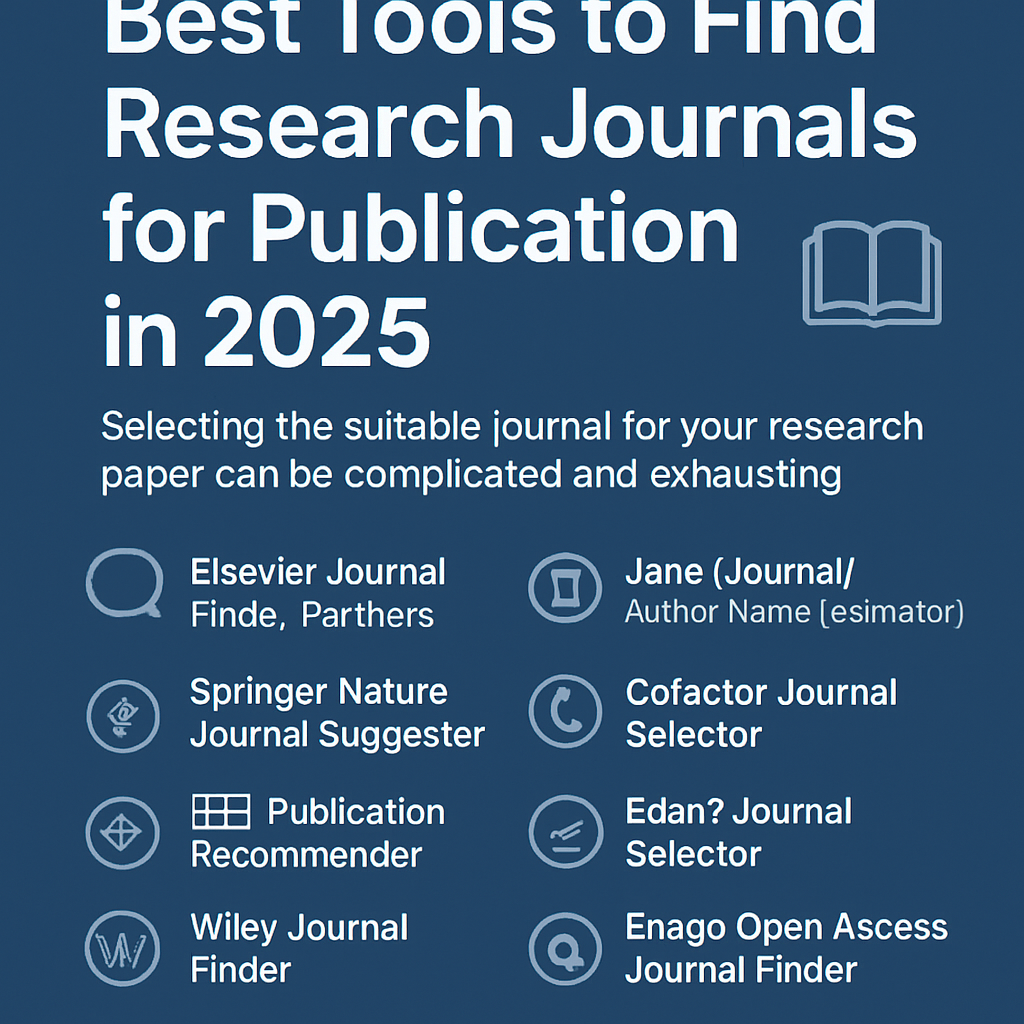
1. Elsevier Journal Finder
Elsevier Journal Finder uses your manuscript’s title and abstract to find the best matches among thousands of Elsevier journals indexed in Scopus. It helps authors narrow down suitable journals by showing relevant metrics, open access options, and estimated review timelines.
Key Features:
- Matches based on title and abstract
- Includes Scopus indexed journals
- Filters for open access availability
- Shows impact metrics and review time estimates
2. Springer Nature Journal Suggester
This tool evaluates your abstract and subject area to provide rapid journal recommendations from Springer and Nature portfolios. It includes information on open access guidelines, journal scopes, and normal review times.
Key Features:
- Fast, accurate journal suggestions
- Scope and submission-to-decision timelines shown
- Open access and hybrid journal options
- Wide subject coverage
3. IEEE Publication Recommender
Perfect for engineering and computer science fields, the IEEE recommender suggests journals and conferences aligned with your manuscript topics. It has filters that let you sort by acceptance rate, review time, and technical scope.
Key Features:
- Suggests journals and IEEE conferences
- Filter by acceptance rate and review duration
- Focused on tech and engineering topics
- Displays journal impact and recent publications
4. Wiley Journal Finder
Wiley Journal Finder matches your manuscript abstract and keywords with journals across life sciences, health, social sciences, and more. It offers insights into indexing, peer review types, and open access availability.
Key Features:
- Abstract and keyword-based recommendations
- Information on indexing and peer review
- Hybrid and open access filters
- Direct links to submission guidelines
5. Taylor & Francis Journal Matcher
Taylor & Francis tool provides journal suggestions particularly useful for social sciences, humanities, and education. It offers detailed metrics, indexing info, and editorial scopes.
Key Features:
- Easy input of abstract for recommendations
- Detailed journal metrics and indexing
- Suitable for humanities and social sciences
- Links to author guidelines and recent articles
6. JANE (Journal/Author Name Estimator)
JANE stands out by comparing your abstract with PubMed articles to recommend journals, authors, and similar articles in the biomedical field. It features confidence scores and citation predictions.
Key Features:
- Matches with PubMed indexed journals and articles
- Citation prediction and confidence scores
- Filters for open access journals
- Identifies similar authors and research
7. Cofactor Journal Selector
Designed for early career researchers, Cofactor’s selector helps avoid predatory journals by focusing on peer review type, indexing, and article processing charges (APCs).
Key Features:
- Filters for peer review and indexing status
- Highlights publication speed and APCs
- Suitable for multiple disciplines
- User-friendly interface
8. Edanz Journal Selector
Edanz leverages AI to recommend journals based on your abstract and keywords. It supports multilingual research by suggesting regional journals and provides detailed journal info.
Key Features:
- AI-powered matching of abstract/keywords
- Supports non-English language journals
- Details on review speed and open access
- Links to language editing services
9. Enago Open Access Journal Finder
Focused on open access publishing, Enago helps authors find OA journals with clear information on APCs, indexing, and peer review timelines.
Key Features:
- Focus on open access journals
- Shows APC fees and indexing data
- Peer review duration information
- Coverage across many disciplines
10. ResearchGate Journal Finder (Beta)
Though still in beta, ResearchGate tools use your profile and publication history to suggest journals your academic peers publish in, applying community-driven data and semantic analysis.
Key Features:
- Personalized journal recommendations
- Uses your ResearchGate profile data
- Community-based insights
- Simple, intuitive interface